
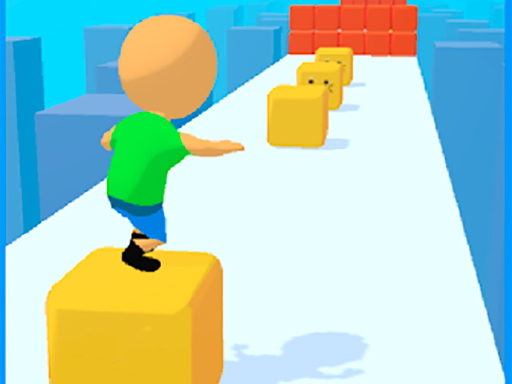
Cube Surf Arcade Adventure
Reviews
Cube Surf Arcade Adventure keeps its scope tight: steer a cube stack, collect cubes, avoid walls, and survive as the pace rises. The procedurally generated corridors prevent memorization, so improvement comes from reading ahead and staying calm under speed. It is best suited to players who enjoy short, score-driven arcade sessions rather than deep progression. The main limitation is the absence of variety beyond that core loop, which the input does not suggest is present.
About this game
Steering a Growing Cube Stack
Cube Surf Arcade Adventure is a hypercasual arcade game built around a single, escalating task: guide a stack of cubes forward through an endless corridor without crashing. You move the stack left or right with a mouse or touch swipe, and the corridor keeps producing new obstacles and pickups. The stack itself is your score and your vulnerability at once — every cube you collect adds height, and every wall you hit ends the run.
Collect, Dodge, Repeat
Cubes appear on the ground ahead of you. Sweeping over them adds them to your stack, which raises your score and changes the silhouette you are steering. Walls block the corridor at intervals, and the only way past is to shift to the open side. As the run continues, the forward speed climbs, so the gap between seeing a wall and reacting to it shrinks. There is no tutorial, no upgrade menu, and no second life — the loop is collect, dodge, and keep the stack intact for as long as your timing holds.
Why Runs Feel Different
Obstacle placement is procedurally generated, so the corridor does not repeat a memorized pattern. That matters for a game this simple: instead of learning a fixed sequence, you learn to read the corridor in the moment. The bright, colorful presentation keeps the stack and the walls visually distinct, which helps when the screen is moving quickly and you are scanning ahead for the next opening.
Reading the Corridor
Because hitting a wall ends the run immediately, the useful skill is anticipation rather than reaction alone. Scanning the corridor ahead gives you time to line up with the open lane before the wall arrives. Collecting cubes raises your score, but chasing a cube that pulls you toward a wall is usually a worse trade than staying on a clean line. Short sessions suit the format: a run can last seconds or several minutes, and the score tracker gives you a concrete reason to try again.
Compatibility
FAQ
Comments
Sign in to leave a review
No comments yet.






Editorial Notes