
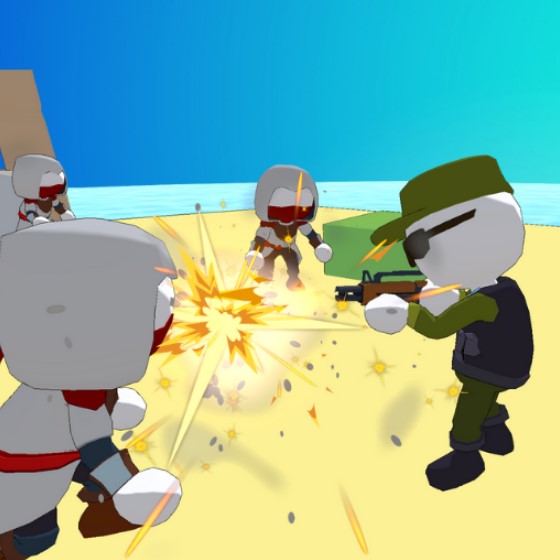
Push Duel: Two Player Challenge
Reviews
Push Duel keeps its scope tight: two players, one arena, and a race to five points. The turn-based structure adds a layer of prediction and positioning that a real-time pushing game would lack, and the minimal controls suit families and younger players. Browser support and no installation lower the barrier to entry. The main limitation is that the game is built strictly for two people, so solo players have no described mode.
About this game
Arena Layout and Scoring
Push Duel places two characters on opposite sides of a simple, uncluttered arena. The playing area is small enough to keep every round short, but positioning still matters because the edge of the arena is the only real hazard. Each successful push that forces the opponent out of bounds awards one point. The current score for both players stays visible at the top of the screen, so neither player has to guess who is ahead. The first player to reach five points wins the match, which keeps individual sessions brief and gives losing players a clear target to chase.
Turn-Based Pushing Mechanics
Players take turns controlling their character. On a turn, the active player aims and performs a push action using the mouse or keyboard. The opponent cannot move or counter during that turn, so each push is a calculated attempt to shift the other character toward the boundary. This turn structure turns every move into a small decision: push now for a safe point, or set up a stronger position for the next turn. Because turns alternate, players must think about where their character will end up after the push, not just where the opponent goes.
Controls and Accessibility
The control scheme is intentionally minimal. Aiming and pushing are handled with the mouse or keyboard, and no complex button combinations are required. That simplicity makes Push Duel easy to pick up for younger players and families, and the game is rated for ages 7 and up. It runs in all modern browsers, supports full screen mode, and needs no downloads or installations. A clean interface keeps the score and win condition visible without distracting from the arena.
Strategy and Timing
Success in Push Duel comes from aim, timing, and reading the opponent. Predicting where an opponent will stand on their next turn helps you line up a push that sends them out of bounds. The arena boundaries can be used deliberately: pushing an opponent toward a corner limits their safe space on later turns. Patience matters too, since a rushed push may leave your own character exposed. Playing repeatedly with a friend or family member is the most direct way to learn these patterns, because the turn-based format rewards observation over reflexes.
Compatibility
FAQ
Comments
Sign in to leave a review
No comments yet.






Editorial Notes