
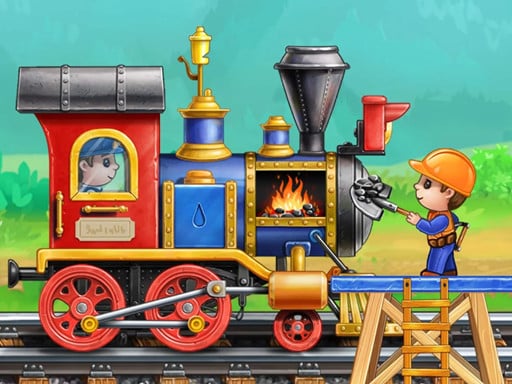
Railroad Builder for Young Learners
Reviews
Railroad Builder for Young Learners targets kindergarten-aged children and keeps its scope narrow: drag track pieces, add platforms and waiting areas, then watch a train run the route. The absence of required reading and the forgiving, guidance-based structure make it approachable for independent play. Its main limitation is that the available information describes a single core loop rather than a progression system, so older children may outgrow it quickly. For preschoolers practicing sequencing and hand-eye coordination, the fit is clear.
About this game
Building a Railway by Hand
Railroad Builder for Young Learners hands children a set of track pieces and asks them to assemble a route. Every piece is placed with a drag-and-drop gesture, which keeps the interaction within reach of small hands and short attention spans. Because the pieces connect visually rather than through text menus, a child can start building without knowing how to read. The immediate feedback — a piece either joins the previous one or it doesn't — turns trial and error into the main teaching tool.
Stations, Platforms, and Passenger Flow
Tracks alone do not complete the scene. Players also place station components such as platforms and waiting areas, then decide where those parts sit along the route. This is where the game quietly introduces sequencing: a platform placed near the start behaves differently from one at the end, and children can see that difference once the train begins to move. [IMG_1] Organizing these elements is the closest the activity comes to a puzzle, and it is also where creativity and planning overlap.
What Happens When the Train Moves
Once a route is finished, a train travels along it, picking up and dropping off passengers at the stations that were built. That animated result is the payoff for every earlier decision. If a track segment does not connect, the train cannot reach a platform, and the child learns cause and effect in a way that is visible rather than explained. The gentle guidance built into the activity lets children experiment with different layouts instead of following a single correct answer.
Skills the Activity Supports
The drag-and-drop interface works on fine motor control, while choosing the order and placement of tracks and station parts exercises logical thinking. Bright graphics hold attention without overwhelming the screen, and the absence of required reading makes the activity accessible to kindergarten-aged children. Because there is no timer or failure state described, children can rearrange their layouts as often as they like, which supports repeated practice and gradual improvement in hand-eye coordination.
Compatibility
FAQ
Comments
Sign in to leave a review
No comments yet.







Editorial Notes