
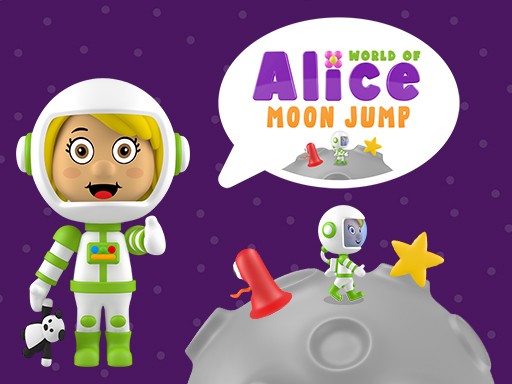
World of Alice: Moon Jump
Reviews
World of Alice: Moon Jump does one thing clearly: it asks children to watch for approaching creatures and tap at the right moment. The automatic speed increase provides progression without menus, and the restart-on-miss design keeps frustration low. Its main limitation is depth—there is little beyond the core jump loop. For parents seeking short, coordination-focused sessions on phones, tablets, or computers, the game fits that narrow purpose well.
About this game
Core Reflex Mechanic
World of Alice: Moon Jump sets a single, clear task: tap or click the screen to make Alice jump over creatures that approach from the left side. Each successful jump adds points. The challenge comes from timing, not from complex inputs or menus, so children can focus entirely on watching the screen and reacting. The game begins at a comfortable pace and gradually accelerates, pushing players to sharpen their timing as the session continues.
Progression and Difficulty Curve
There are no levels to select or settings to adjust. The game itself becomes faster the longer a player lasts, which means difficulty scales automatically with performance. Missing a jump has a mild consequence: the run ends and the player starts over. That design keeps frustration low while still giving children a reason to concentrate. Repeated attempts naturally build muscle memory for when to tap.
Visual Style and Platform Support
The game is set in a colorful lunar landscape, with simple graphics that suit its young audience. It runs on cell phones, tablets, and computers, so the same experience is available across common household devices. The cheerful presentation and absence of complex rules make it easy for young learners to start playing without adult instruction.
Who It Suits
Parents looking for productive screen time will find a game built around reaction training rather than storytelling or competition. The lack of penalties beyond restarting encourages children to try again and improve. Because the premise is so simple, it works best for short sessions where the goal is coordination practice rather than extended play.
Compatibility
FAQ
Comments
Sign in to leave a review
No comments yet.






Editorial Notes